
Automate and Control LTD

Month: April 2024

  • Automate and Control’s AI Driven Machine Vision Systems for the Food Industry. How does Machine Learning benefit our customers.

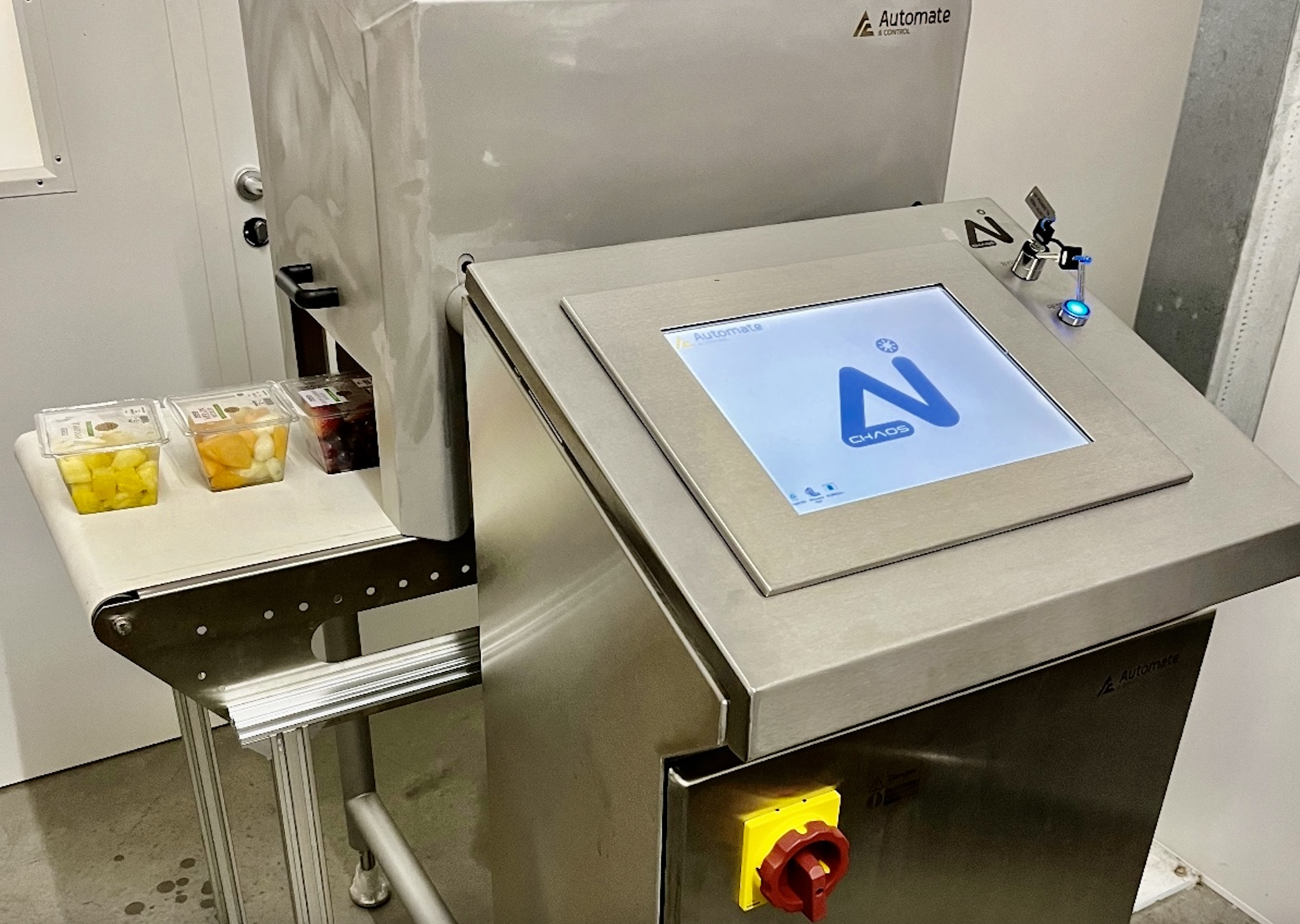
    Revolutionizing Food Industry Operations with Chaos AI Vision Systems

    Harnessing the Power of Artificial Intelligence for Seamless, Future-Proof Automation

    At Automate and Control, we are excited to introduce our cutting-edge Chaos AI Vision Systems tailored for the food industry. These systems are not just another technological gimmick; they represent the very core of artificial intelligence integrated into robust machine vision solutions.

    AI at the Core: Future-Proofing Your Operations

    The term “AI” often buzzes through the tech landscape, yet at Automate and Control, it signifies a profound transformation. Our Chaos AI Vision Systems are built around a core of advanced AI, ensuring that they are not just solutions for today but are future-proof for the evolving demands of the food industry. With our AI-driven systems, the dependency on highly trained vision software engineers is a thing of the past. Now, even operators with basic technical know-how can set up and manage complex applications, thanks to our intuitive, machine-learning enhanced setup systems.

    Empowering Operators with Simple, Powerful Tools

    Our vision systems come equipped with user-friendly interfaces that allow operators to easily configure and deploy new applications. This shift from engineer-dependent setups to operator-led configurations reduces setup times and operational downtime, thereby increasing efficiency and reducing costs. The built-in machine learning capabilities ensure that the system continuously learns and adapts, improving its accuracy and functionality with each use.

    Comprehensive Capabilities for the Food Industry

    The Chaos AI Vision Systems are designed to handle a wide array of tasks critical to the food industry:

    • Variable Data Checking: Ensure all product data matches across batches.
    • Random Packed Product Identification: Easily identify and sort products regardless of their packing arrangement.
    • Barcode and QR Code Inspection: Maintain accuracy in code reading to support tracking and distribution.
    • Quality Grading: Automatically assess product quality to ensure only the best items reach consumers.
    • Anomaly Detection: Quickly spot and address deviations from the norm, preventing potential issues before they escalate.
    • Labeling and Date Coding: Check for missing or incorrect labels and date codes, crucial for regulatory compliance and consumer safety.

    Robust Remote Support for Uninterrupted Operations

    Understanding the critical nature of food industry operations, our Chaos AI Vision Systems are backed by comprehensive remote support. This ensures that any operational hiccups can be swiftly and efficiently resolved, maintaining high uptime and productivity. Our expert team can remotely diagnose and rectify issues, reducing the need for on-site visits and further ensuring that your operations run smoothly around the clock.

    Seamless Integration with Upstream and Downstream Equipment

    At Automate and Control, we understand that the effectiveness of our Chaos AI Vision Systems extends beyond their standalone capabilities. Integration with existing production lines and systems is crucial for maximizing efficiency and effectiveness in the food industry. Our vision systems are designed with advanced protocol support to seamlessly communicate with both upstream and downstream equipment, such as sealing, coding, and weighing machines.

    Advanced Protocol Support for Diverse Equipment

    Our Chaos AI Vision Systems support a multitude of protocols, ensuring they can easily connect with various types of production equipment. This interoperability is key to streamlining production processes and enhancing the synchronization between different stages of production. Whether it’s integrating with older legacy systems or the latest in automation technology, our systems are equipped to handle:

    • Industrial Network Protocols: Including but not limited to Ethernet/IP, Modbus TCP, PROFIBUS, and PROFINET, ensuring that our systems can communicate effectively across the most widely used industrial networks.
    • Standard Communication Interfaces: Support for USB, RS-232, RS-485, and wireless communications facilitates flexible connectivity options.

    Enhanced Production Line Efficiency

    By integrating our Chaos AI Vision Systems with sealing machines, for instance, operators can ensure that once the AI system identifies and confirms the quality of packaged goods, the information can directly trigger the sealing process without manual intervention. Similarly, integration with coding and weighing equipment allows for a streamlined workflow where products are inspected, weighed, and coded in one smooth, continuous process, reducing handling times and minimizing the risk of errors.

    Real-Time Data Sharing and Process Optimization

    Our integrated systems allow for real-time data sharing between equipment, enabling immediate adjustments and process optimization. For example, if the vision system detects a discrepancy in product weight, this information can be instantly relayed to the weighing equipment to re-calibrate and correct future measurements. This capability not only enhances accuracy but also significantly improves the overall productivity and efficiency of the production line.

    Customizable Integration Solutions

    Recognizing that each production facility has unique needs, Automate and Control offers customizable integration solutions. Our team works closely with clients to assess their specific equipment and integration requirements, ensuring that the implementation of our Chaos AI Vision Systems enhances overall operational flow and meets the specific needs of each facility.

    Conclusion: A Smarter Way to Automate

    At Automate and Control, we believe in leveraging technology to make industrial operations not just automated but smartly automated. Our Chaos AI Vision Systems embody this philosophy by providing the food industry with a powerful, intelligent tool that is simple to use, future-proof, and capable of handling multiple complex tasks efficiently. Embrace the future of food industry automation with us and ensure your operations are not just running, but running at their optimal best.

    With Chaos AI Vision Systems, the promise of a fully integrated, highly efficient production line is now a reality. By supporting a multitude of protocols and offering seamless integration with a variety of upstream and downstream equipment, our systems not only enhance individual processes but also transform the entire production ecosystem. Step into the future of integrated automation with us and experience unparalleled efficiency and productivity in your food industry operations.

    Visit us at automateandcontrol.com to learn more about how our Chaos AI Vision Systems can transform your food industry operations today.

  • Hyperspectral Imaging in Food Safety

    Hyperspectral Imaging and Food Safety

    Hyperspectral Imaging and Food Safety: A Comprehensive Analysis

    Introduction

    Food safety is a critical global issue, impacting public health and economic stability. Hyperspectral imaging (HSI) has emerged as a transformative technology in this area, offering unprecedented precision in detecting contaminants and assessing food quality. HSI’s ability to analyze the chemical and physical properties of foods non-invasively is revolutionizing food safety protocols and enforcement.

    Fundamentals of Hyperspectral Imaging

    Technical Specifications: Cameras and Sensors

    Hyperspectral cameras utilize CCD or CMOS sensors to capture data across hundreds of spectral bands. CCD sensors are known for their high-quality images and low noise, while CMOS sensors offer faster processing times and lower power consumption.

    Dale, 2021

    Key Differences from Multispectral Imaging

    Hyperspectral imaging captures a continuous spectrum for each pixel, offering more detailed data than multispectral imaging, which captures only discrete bands and is less detailed.

    Johnson and Finkelstein, 2020

    Hyperspectral Imaging in Food Inspection

    HSI’s detailed spectral data enables precise identification of organic and inorganic materials, enhancing food safety by detecting pathogens, pesticides, and other contaminants more effectively than traditional methods.

    Smith et al., 2022

    Case Studies

    • A 2021 study published in Food Safety Journal demonstrated how HSI successfully identified E. coli on the surface of fresh produce with 98% accuracy. Chen and Zhao, 2021
    • Another case study involved using HSI to detect foreign bodies in cereal products, where traditional methods failed to identify smaller contaminants. Miller and Brown, 2022

    Hyperspectral Imaging for Process Monitoring in the Food Industry

    Quality Control During Food Packaging

    HSI systems monitor the integrity of food packaging, detecting minute defects that could lead to spoilage or contamination. This application was highlighted in a 2022 study where hyperspectral cameras identified seal defects in meat packaging that were not visible to the naked eye.

    Roberts and Garfield, 2022

    Monitoring Changes in Food During Storage

    Hyperspectral imaging can track the degradation of food products during storage by detecting changes in their spectral signature, predicting spoilage before it becomes visible.

    Liu et al., 2023

    Advantages of Hyperspectral Imaging in Food Safety

    The implementation of HSI technology in food safety offers numerous benefits over traditional methods:

    • Increased Accuracy in Detecting Pathogens and Contaminants
    • Non-destructive Testing and Real-time Analysis Capabilities

    Challenges and Limitations

    High Costs and Complexity

    The high cost of hyperspectral imaging equipment and the complexity of analyzing the data remain significant barriers. These challenges are detailed in a recent market analysis by Global Food Safety Resources (GFSR), which discusses the adoption rates and technological hurdles in implementing HSI in smaller food processing operations.

    Global Food Safety Resources (GFSR), 2022

    Data Management and Processing

    The large datasets produced by HSI require substantial processing power and sophisticated algorithms to be useful in real-time decision-making. This issue was addressed in a recent IEEE publication, which presented a new algorithm designed to speed up data processing in HSI systems.

    Nguyen et al., 2023

    Regulatory Aspects and Compliance

    Regulatory compliance is critical for HSI technology in the food industry. Various standards and protocols must be adhered to, ensuring that hyperspectral imaging systems are reliable and effective. The FDA’s recent guidelines on hyperspectral imaging provide a framework for its application in food safety inspections.

    Food and Drug Administration (FDA), 2022

    Conclusion

    Hyperspectral imaging represents a significant advancement in food safety, offering detailed insights that improve contaminant detection, quality assurance, and regulatory compliance. As technology progresses, its adoption is expected to increase, making it an indispensable tool in the global effort to ensure food safety.

    Future Directions

    Emerging trends include integrating AI with HSI to enhance data interpretation and developing more cost-effective hyperspectral cameras to promote broader usage in the food industry.

  • Transforming Food Safety: The Impact of Hyperspectral Machine Vision Technology by Automate and Control LTD

    Transforming Food Safety: The Impact of Hyperspectral Machine Vision Technology by Automate and Control LTD

    Introduction

    Hyperspectral machine vision systems offer unparalleled precision in detecting defects and contaminants in the food production line. Automate and Control LTD is at the forefront of integrating this technology into food safety processes.

    Understanding Hyperspectral Imaging

    Hyperspectral imaging captures a wide spectrum of light, far beyond what the human eye can see, allowing for detailed analysis of materials based on their molecular composition. This technology is particularly effective in identifying subtle differences and impurities that are invisible to conventional imaging systems.

    Advancements in Food Inspection

    Automate and Control LTD’s hyperspectral systems are revolutionizing how the food industry detects contaminants. By analyzing the spectral data, these systems can identify foreign materials such as plastic or metal, as well as biological hazards like maggots or mold, even in complex visual scenes.

    Broader Industrial Applications

    Beyond food safety, hyperspectral imaging is reshaping various industries including pharmaceuticals, where it’s used for fault detection in pills, and agriculture, for assessing crop health. This versatility underscores the technology’s significant benefits in enhancing product quality and safety across multiple sectors.

    Future Prospects

    The ongoing advancements in hyperspectral imaging promise even greater integration into industrial automation. With improvements in speed and accuracy, the potential applications of this technology continue to expand, promising a future where hyperspectral machine vision is a standard tool in many industries.

    Conclusion

    Automate and Control LTD is not just enhancing food safety but is setting new standards for quality control across industries with its advanced hyperspectral machine vision systems.